Executable running network
Page status: executable fixture, local solver evidence, and a derived state-conditioned radiality witness; claims are versioned and verification-scoped.
Status and purpose
Empirical artifact, version 0.1.0. The semantic specification now has a numerical realization in data/running-network/v0.1.0.json. The fixture is synthetic. Its values are chosen to make representation choices observable, not to recommend equipment ratings or a particular feeder design.
BMOPFTools is the first implementation platform because its model retains ordered conductor terminals, full impedance matrices, explicit grounding, parallel branches, switches, and an independent n_winding transformer model. The book-level specification remains implementation independent.
What is realized
| Object class | Source identities | Numerical feature under test |
|---|---|---|
| buses | $i_0,\ldots,i_6$ | nonuniform ordered terminal sets |
| switch | $w_0$ | fixed closed state and per-conductor current limits |
| parallel lines | $\ell_1,\ell_2$ | distinct full impedances and distinct limits |
| coupled line | $\ell_3$ | full four-conductor series matrix |
| mapped line | $\ell_4$ | $[a,c,n]\mapsto[c,a,n]$ conductor permutation |
| grounding | $h_n$ | finite neutral-to-earth admittance at $i_2$ |
| transformer | $x_1$ | WYE–WYE–DELTA three-winding model with winding limits |
| loads | $d_1,d_2,d_3,d_4$ | unbalanced wye, single-phase, and delta demand |
| generator | $g_1$ | bounded continuous active and reactive decisions |
BMOPFTools requires each single-phase load to be a two-terminal component. The source load $d_2$ is therefore compiled into d2a and d2c. That realization is recorded explicitly rather than silently redefining a partial-wye object.
Six views of the same source
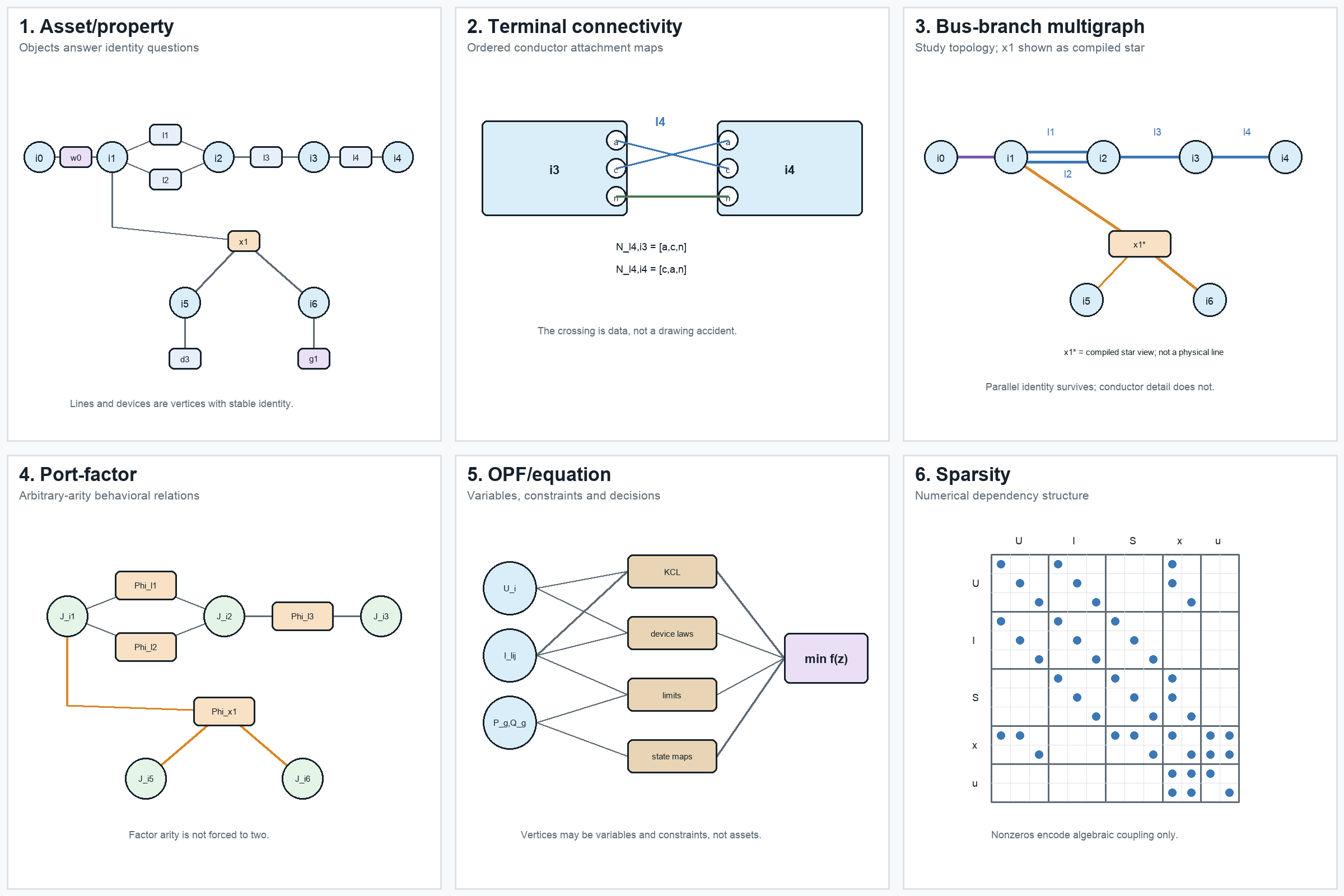
The panels are not levels in a single hierarchy. The provenance artifact also contains a non-visual simple-topology quotient used by the cycle and radiality definitions:
- the asset/property view retains stable physical identity;
- the terminal view exposes ordered conductor mappings and grounding;
- the bus–branch multigraph supports conventional network algorithms while retaining $\ell_1$ and $\ell_2$ separately. In the figure, $x_1^*$ is an explicitly labelled compiled star used to draw the multi-terminal device; it is not a claim that the transformer is physically three two-terminal lines;
- the port–factor view represents $x_1$ as one factor of arity three;
- the OPF graph makes variables, constraints, limits, and decisions explicit;
- the sparsity graph records numerical coupling but does not claim that a nonzero is a physical branch.
Every generated view must retain a source map. A label such as Phi_x1 is a generated factor identity with source = x1; it is not a replacement asset ID. The complete maps for the six illustrated views, together with the derived simple-topology quotient, are generated in experiments/generated/view-source-maps.json. Automated checks require every generated object to identify an existing fixture source and bind the map to the exact fixture and figure hashes.
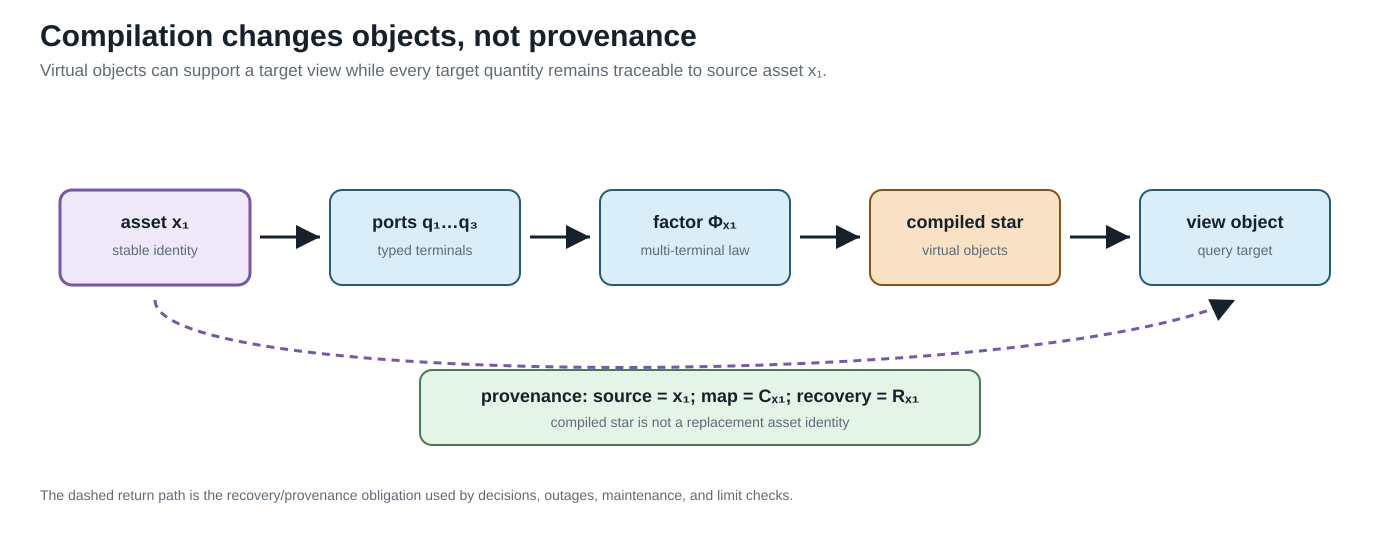
The lineage is the operational companion to the view figure: virtual compiled objects are allowed, but source identity, map identity, and recovery remain available for limits, outages, maintenance, and decisions.
Executed checks
The generation script parses the exported BMOPF JSON, runs JSON-schema and model-conformance checks, solves a determined power flow, and solves an OPF with $g_1$ dispatchable. The current artifact reports:
| Check | Result |
|---|---|
| schema valid | yes |
| validation errors | 0 |
| validation warnings | 0 |
| expected map diagnostic | I.TMAP.CROSS_PHASE_LINE |
| expected map diagnostic | I.TMAP.PERMUTED_ORDER |
| power-flow termination | LOCALLY_SOLVED |
| power-flow active loss | 554.317 W |
| OPF termination | LOCALLY_SOLVED |
| OPF objective | -13.2000 |
The negative generator cost is a test device that drives $g_1$ to its active power bounds, making the continuous decision observable. The objective has no economic interpretation. Both the cost and this interpretation must change before the case is used for an economic study.
Reproduce the recorded review case
The September review adds an isolated run with a recorded Julia environment, case-source hashes, and an explicit BMOPFTools commit. From the repository root:
bash scripts/reproduce_clean_fixture.sh --check
bash scripts/reproduce_clean_fixture.sh
The first command validates recorded input hashes. The second requires the Julia version recorded in the profile, clones the pinned dependency into a fresh run directory, installs the locked environment, regenerates the fixture, compares selected numerical outputs with declared tolerances, and runs the verification lesson. The recorded export uses a different schema URI from the August fixture; the workflow checks equality of all engineering fields and records that metadata difference. Pinned replay additionally checks the exact recorded export hash. It prints the run directory and retains its inputs, resolved environment, results, and execution log. It never replaces the maintained evidence. Add --offline when the pinned Julia packages are cached. Use --output /path/to/a/new/run to choose a new directory outside the repository.
The profile is in experiments/reproduction/review-2026-09-06/. It binds the specific case sources by hash because this is an author-review working-tree snapshot, not a newly published book commit. It is a new recorded run; it does not repair missing metadata in an earlier experiment. Profile validation fails if a bound input changes. For a fresh development check instead, use:
bash scripts/reproduce_clean_fixture.sh --mode currentCurrent mode uses the dependency repository's HEAD and resolves dependencies afresh. It tests the fixture and scoped verification but does not claim the pinned numerical comparison. Readers should use these isolated commands when comparing evidence; direct run_*.jl generators are maintainer commands that can replace artifacts in the working tree.
Historical August record
The preserved August fixture record at BMOPFTools commit b7aa9a1bb48bcc8b790d3bcf5417d6a32036352a remains under experiments/generated/clean-reproduction. Its complete resolved environment was not recorded. Its original generated_at date was emitted as a constant by the old generator and must not be treated as authenticated execution time. The current generator separates fixture definition date from the actual UTC run timestamp. New run metadata is separate from deterministic fixture identity.
An explicitly requested historical reconstruction can use the old dependency revision with freshly resolved dependencies:
bash scripts/reproduce_clean_fixture.sh --mode historical-reconstructionThat operation does not reconstruct the missing historical environment, does not run newer verification APIs unavailable at the old revision, and makes no full historical numerical-replay claim. It writes to a fresh directory.
Check the returned solution
The current verification exercise can also run directly, without writing files:
julia --project=experiments experiments/lessons/verify_running_network.jlIt calls BMOPFTools profile_solution for supported voltage, device-limit, load-law, and network power-balance checks. It also calls the package's line_yprim for every line, evaluates each terminal-current map at the returned complex voltages, and compares the recovered currents with the reported currents. The comparison includes the l4 conductor permutation. The declared absolute tolerances are $10^{-5}$ A for line-current consistency and $10^{-3}$ W/var for the reported network power balances. They are numerical acceptance tolerances for this fixture, not measurement accuracy or a global optimality guarantee.
A second result adds 1000 V to the real part of terminal i2.a, updates its magnitude and angle consistently, and leaves the reported currents untouched. It must trigger a voltage-limit finding and fail line-current recovery. The original result remains unchanged. Active-bound and initialization findings are retained in the report rather than treated as execution failures.
Evidence boundary. Post-solve evaluation is separate from the JuMP constraints, but the inputs and package primitive construction are shared. The profile's network power balance uses reported device powers/losses; the additional line recovery independently checks consistency with line primitives. This does not independently recalculate every transformer/device equation or nodal KCL from the original physical specification.
Accordingly, calling check_solved_network_feasibility on this result returns indeterminate: its required full independent residual bundle is absent. The lesson asserts that refusal. Supplying zeros for missing residuals would be an invalid way to obtain a pass. Full all-device/KCL verification remains a package-owned extension, and physical model adequacy requires other evidence.
Version 0.1.0 realization boundary
The versioned fixture is the current numerical contract, not a silent completion of every object in the semantic specification. It includes the declared $d_4$ delta demand and $h_{\mathrm{ref}}$ tertiary reference shunt, and it retains $w_0$ as a fixed closed switch. It does not add an undeclared $g_2$ generator or any other convenience object merely to make a continuous solve look more complete. Future fixture versions may promote semantic-only controls, but must change the version, source hashes, and provenance together.
Derived running-network topology states
The generated experiments/generated/running-network-radiality-witness.json lifts the topology predicates to this same fixture without changing version 0.1.0's continuous PF/OPF contract. It retains the four line identities, the $w_0$ switch, the two compiled transformer winding connections, and every ordered terminal map. Four derived states are compared: base switch closed, switch open, $l_2$ outage, and the combined switch-open/$l_2$-outage state.
The base and switch-open states remain member-nonradial because $l_1$ and $l_2$ are parallel members, even though their simple adjacency projection is radial. Removing $l_2$ removes that member cycle. The witness therefore reports both predicates and preserves transformer-factor provenance rather than treating the bus quotient as the source topology.
What remains semantic-only
The fixture currently treats $w_0$ as fixed closed. Discrete switching, contingency selection, investment choices, measurements, and protection zones remain in the semantic specification but are not claimed as executable in version 0.1.0. This boundary prevents a successful continuous OPF from being mistaken for validation of the full decision model.